
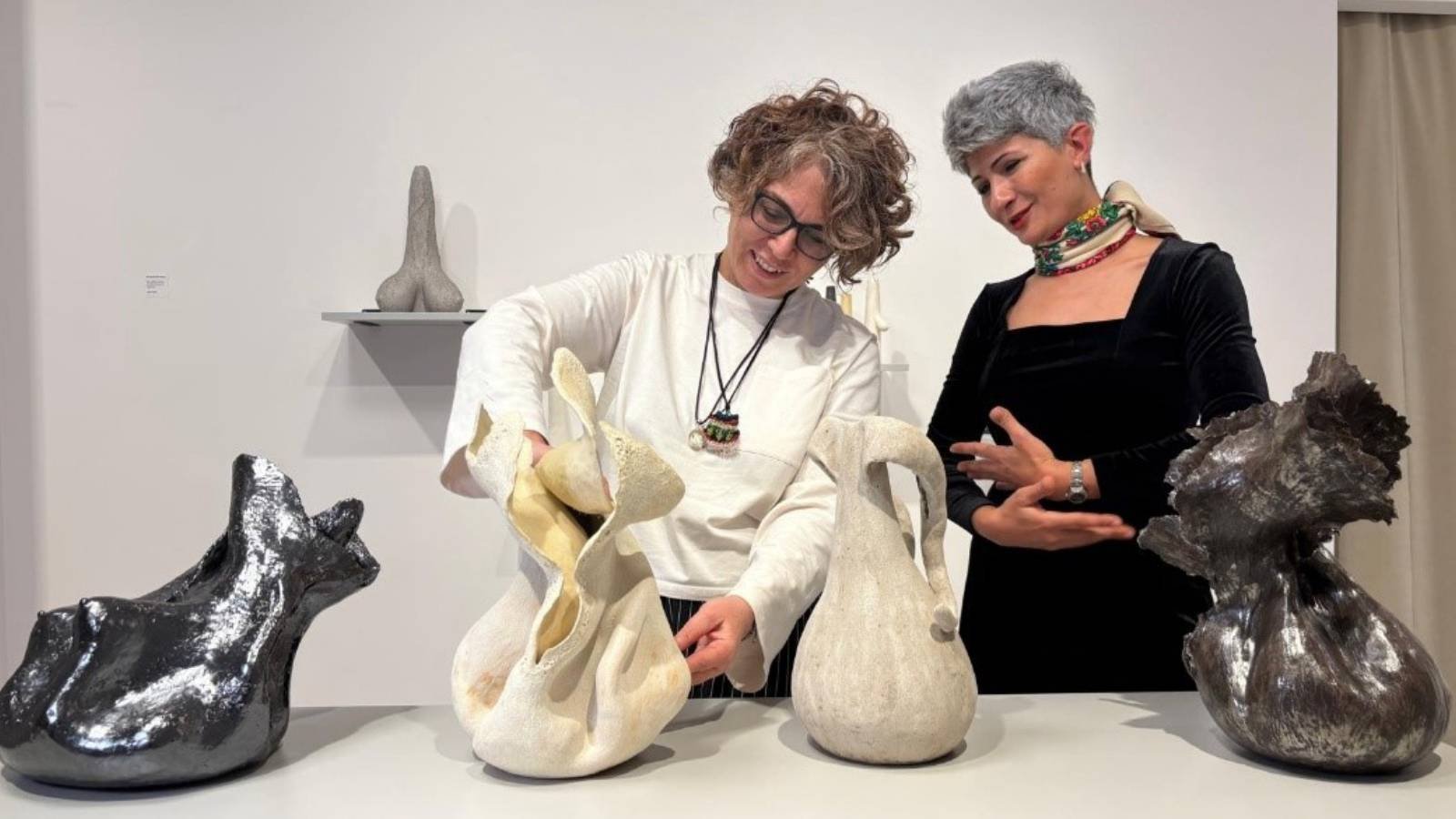
She worked as a volunteer psychologist in Yazidi camps, translating the lament into ceramics
Gülsüme Oğuz: I worked on memes without worrying about being labeled; memes are conscience, they are compassion.
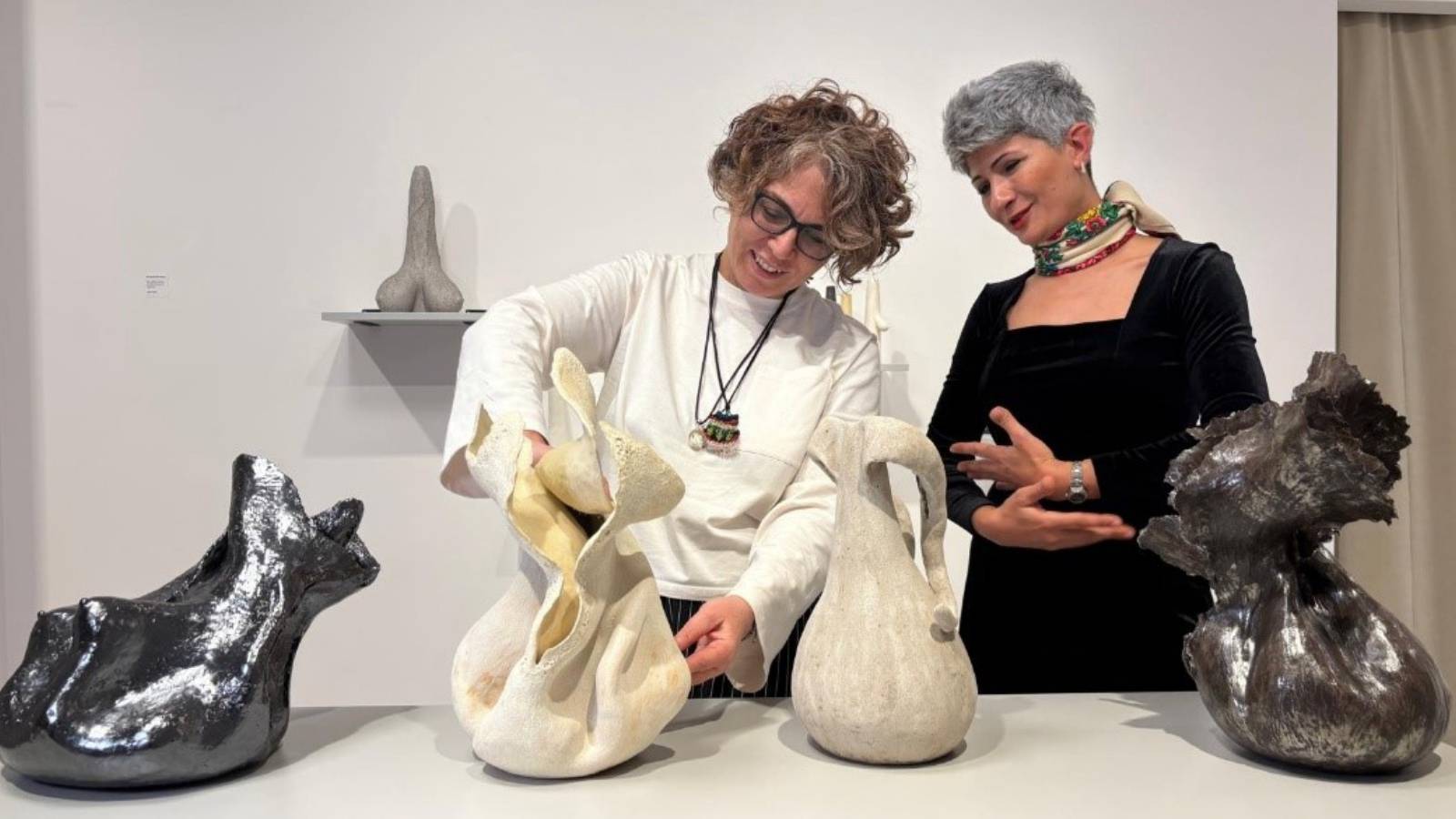
Candan Yıldız (left) and Gülsüme Oğuz
Does art heal?
Perhaps yes, perhaps no.
But multiplying goodness heals.
Those whose faces, ears, and consciences are turned towards what is happening around them will remember. In 2014, Yazidis who survived the massacre and forced displacement by ISIS, the dark organization of the Middle East, came to Turkey. They were settled in villages and camps in Diyarbakır, Mardin, Batman, and Şırnak. Gülsüme Oğuz, who provided psychological support to Yazidi women and children in those camps and lived with them for a year, transferred the lament of that period, partly for healing, into clay and ceramics with a feminist perspective.

Gülsüme Oğuz (left) and the exhibition curator Tilbe Şendoğan
“Because I’m a psychologist, people normally want to be sure I won’t tell anyone when they tell me their stories. But when the Yazidis started telling their stories, they kept saying, ‘Tell this to others.’ And this matter of telling became both a legacy and a burden for me. And I didn’t know how to tell it. Because they were very heavy stories. I tried to tell them in words, but my throat would tighten.”
For someone who is at one with the human soul, becoming one with clay, or ‘getting one’s hands dirty,’ must be the healing power of it. That’s exactly what happened for Gülsüme Oğuz. She delved into a field she knew nothing about – ceramics – and began working day and night in her humble workshop.
The exhibition at Aynalı Geçit Gallery continues.
“When I first encountered ceramics a year and a half ago, I thought I could express myself through the language of art. What the Yazidis meant when they said, ‘You know their language,’ could be art. Because everyone could understand that language. What they told me in the Yazidi camp stayed with me. I wrote stories, but it wasn’t enough. I couldn’t handle it. My consciousness was fading, and I would faint. I needed to get rid of that burden for myself, and also because I had been given the legacy of ‘Tell these stories to others.’”
Gülsüme Oğuz, who went to the Yazidi camp in Silopi to ‘heal’ people but returned herself lamenting, used ‘witness therapy’ as a way of feeling the pain of those who suffered oppression. The burden or obligation to tell and make known was transformed into an exhibition.
Gülsüme Oğuz opened her first solo exhibition, titled ‘The Hero’s Eternal Exile,’ at the Aynalı Geçit Gallery in Beyoğlu, Istanbul. The exhibition was curated by Tilbe Şendoğan.
“My grandmother used to make clay ovens. Maybe it’s something that comes from there. Ceramics became something that gave birth to me. Something had to be born from me, not just come out of me. Clay is something that transforms. And I didn’t want to listen to anyone, I worked without worrying about being labeled. I found a dilapidated shop. With my limited resources, I turned it into a workshop. I filled it with clay, bought glazes. I would throw myself into the workshop in the morning, and before I knew it, it was evening… Except for one week, I went to my workshop every day for a year.”
 From Gülsüme Oğuz’s exhibition ‘The Hero’s Eternal Exile’
 From Gülsüme Oğuz’s exhibition ‘The Hero’s Eternal Exile’
Gülsüme Oğuz, a female psychologist who attributes the meaning of “the source of love, compassion, and conscience” to the breast, explained the following about her works in various forms:
“When I think historically about the female body, the female breast has been subjected to inhumane treatment. On the other hand, we feel our emotions in our breasts. We hug through them. When we are devastated, we want to tear our breasts apart. When we are happy, our breasts overflow. With all of this here, what else could I have done besides making a breast image?”
The exhibition features breast figures in many different forms and colors. The piece that evoked a ‘saw’ effect was particularly striking.
 From Gülsüme Oğuz’s exhibition ‘The Hero’s Eternal Exile’
 From Gülsüme Oğuz’s exhibition ‘The Hero’s Eternal Exile’
“Men exploit us women by saying, ‘You’re a rose, a flower, delicate.’ That’s why I made one of my works like a saw. Each one is made from different clay… The breasts all speak different languages… They all say the same thing: We don’t want conflict.”
The exhibition has so far traced the routes of the camps where the Yazidis stayed. Its final stop was Istanbul. The next goal is to connect the exhibition with Yazidis who have migrated to Europe.
The Yazidis, an ancient people, gave us an opportunity to remember kindness as they departed. And of course, Gülsüme Oğuz too…
Leave a Reply